
Erstwhile Okie on St. Mark's Place. "That which hath been is now; and that which is to be hath already been; and God requireth that which is past."
· 1 min read
1 years ago
#BooksOf2025
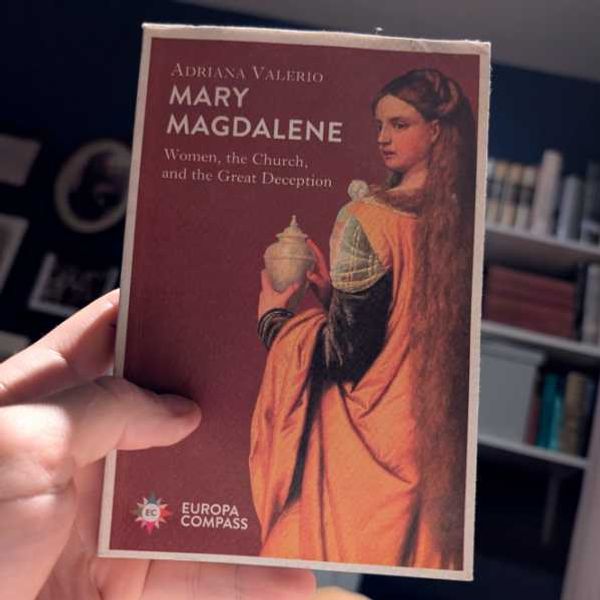
3. Mary Magdalene: Women, the Church, and the Great Deception
6/10
GOOD: Brief, accessible, and interesting points
BAD: Feels a bit cursory; an assemblage of proofs of a point that doesn't need much proof
Not thrilled to be sharing only my third book of the year well into March! In fact, February was dominated by The Thin Red Line, with which I was nearly finished when Lent arrived and I decided to only read explicitly Christian literature until Easter.
At any rate, this little volume had caught my eye in The Strand a while back, so I picked it up.
At its heart, the book critiques the denial of authority of women in the Church, pointing to Mary Magdalene as the first Apostle; having been the first to proclaim the news of Christ's resurrection. Interwoven is an examination of the conflation of unnamed women in the Gospel with her, making her, in church tradition, a prostitute though this is not a Biblical view.
That's really about it, but the point is illustrated by various gnostic texts and apocrypha (new to me was the x-rated Greater Questions of Mary.)
Quick and interesting read, but probably not especially memorable.
· 4 min read
1 years ago
#BooksOf2025
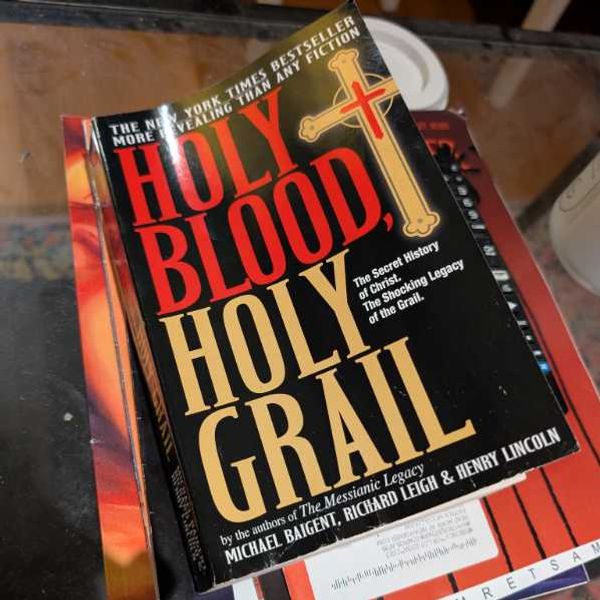
2. Holy Blood, Holy Grail by Michael Baigent, Richard Leigh, and Henry Lincoln
6/10
GOOD: Fascinating history from a number of discrete periods
BAD: Since debunked; Silly logical contortions to align with the desired conclusion
I'm going to be in Paris in May for meetings and wanted to take advantage of being on the continent by squeezing in some culture. Somehow I heard of a basilica in the South of France where Mary Magdalene's purported skull is displayed inside of a golden body. Evidently, there's a monastery with spartan accommodations to host pilgrims who then have to hike through the woods to access it. It seemed interesting, like something the characters in an Italian neorealist movie would do.
I mentioned it to a friend who referenced this book and some complex conspiracy about Mary Magdalene having been married to Christ and borne his children and carried the Holy bloodline to France. Popularly known more recently as the underlying conspiracy of The Da Vinci Code. So I bought the book and dove in.
It begins with the story of a priest in the late 1800s having been assigned to a tiny parish in the South of France. He eventually refuses the Church's order to be moved to another parish, seems to exhibit a sudden great wealth, behaves strangely, and finds hidden ancient parchments left by a Knight of the Crusades.
From there we try to establish that the famous Knights Templar were patronized by a secret society later connected to a particular Frankish royal family which lost power but seemed to have many prominent descendants in later centuries behind many major historical events.
SPOILER ALERT: This royal line was sired by Jesus, who was just a man, and if it is ever restored, it will unite Jews, Christians, and Muslims as the human view of Jesus is acceptable to all.
It's a pretty dense book, and they work through each step of this methodically. Much of their source material has, in the forty-plus years since publication, been debunked as fraudulent, but while they contort and connect and make spurious leaps, they do it all over a background of well-researched and interesting history. I learned a lot about the Knights Templar, and the Kingdom of Jerusalem, and the history of Franks and France and Visigoths. I also learned a lot about the Holy Grail (for instance that the word 'grail' has no other meaning than to refer to the Holy Grail...) and the literature around it.
But the part of it I enjoyed the most was the Biblical criticism. I consider myself a Christian Fundamentalist, and genuinely hold the admittedly absurd and indefensible view that the Bible is literally true and inerrant. But if you really believe in something you should be comfortable with it being assailed.
Reading about the Roman Emperor Diocletian's role in destroying much of the Christian Canon was fascinating, and I find arguments that the established Gospel was molded to be acceptable to Roman authorities compelling. There are also some compelling arguments that Jesus was not a humble carpenter but a well-to-do and well-connected member of an established Messianic line. Even relatively minor arguments that, for instance, the beloved disciple of the Gospel of John was not John, but Lazarus, were fascinating.
So on the whole, I don't ascribe a lot of value to the book, but it proved as fun a way as any to learn about topics I might not otherwise have been exposed to. And I admire a peripheral stated goal which is to united discrete scientific disciplines in the pursuit of truth. There's an aside about that I found thought-provoking:
"Why, then, had the fragments of the puzzle not hitherto been assembled into a coherent whole? [...] Since the so-called Enlightenment of the eighteenth century, the orientation of Western culture and consciousness has been toward analysis rather than synthesis. As a result our age is one of ever-increasing specialization... In consequence the diverse spheres covered by our inquiry have traditionally been segmented into quite separate compartments... [F]ew experts on the Grail romances have been historians... Similarly historians of the Templars and the Crusades have, like all historians, adhered closely to "factual" records and documents... To suggest to such a historian that the Grail romances might contain a kernel of historical truth would be tantamount to heresy, even though Schliemann, more than a century ago, discovered the site of Troy by dint of careful reading of Homer."
I love this as a defense of "fiction" as often being a greater aid of truth than "non-fiction" and as an exploration of what truth is generally.
Notwithstanding thou mayest kill and eat flesh in all thy gates, whatsoever thy soul lusteth after, according to the blessing of the LORD thy God which he hath given thee: the unclean and the clean may eat thereof, as of the roebuck, and as of the hart.

Worship
· 1 min read
3 years ago
Newly obsessed with the idea of early pilgrimages to the Holy Land, such as the Pilgrimage of Etheria, a woman in the 4th Century who wrote letters home describing her journey. Her descriptions of being shown Biblical sites by local monks and attending liturgies so near the time of Christ blows my mind. To think of seeing Christ's Tomb with the same sense of reality and immediacy as I might have with Plymouth Rock...
· 2 min read
3 years ago
I've undertaken reading through the Bible in its entirety, which I haven't done in a few years. It's inevitably a faith-challenging experience because--to really distill it:
1. I have long since committed to fundamentalism and the view that the Bible is literal and inerrant.
2. The Old Testament is ridiculous.
So doing this kind of study, as opposed to just reading the more sort of guiding, nourishing stuff of the New Testament can get me into a mode of my religious life being more intellectual than spiritual. It led me, this morning, as I was praying before doing a reading, to ask God why He prizes faith so much. Why would He rebuke the disciple who wanted to see His wounds before believing He was truly resurrected?
Outside of one's own religion, I don't think anyone ever sees blind unquestioning faith as a virtue. And God encourages reason, calling us to "be ready always to give an answer to every man that asketh you a reason of the hope that is in you."
One of the things that past readings through the Old Testament did give me though, was astonishment at how little miracles can move people. The very people that saw the Red Sea parted and walked through it with Moses in very short order questioned the very existence of God. And is that really any different from me coming into consciousness every morning, drawing breath that puts some parts of the ether into my blood and lends me the ability to see, speak, move?
But still, I tried to go beyond my own mental justifications and asked God to give me something in my reading as an answer. Knowing that my reading was something He smiled on, serving as a knock on the door that He promises to answer.
And surely enough, I was satisfied with the New Testament chapter I was given, in which the disciples--not one, but all of them, apparently--ask Jesus a question that I think was very similar, in a sense, to the one I was asking: Why speakest thou unto them in parables?
His answer, from Matthew 13:11 - 17 is worth reading (Since, you know, they're the words of Christ), but in particular I appreciated:
By hearing ye shall hear, and shall not understand; and seeing ye shall see, and shall not perceive: [...] But blessed are your eyes, for they see: and your ears, for they hear.
[...]
many prophets and righteous men have desired to see those things which ye see, and have not seen them; and to hear those things which ye hear, and have not heard them.
Easter service
· 1 min read
9 years ago
First discovered this poem in high school in a thick volume of religious verse that belonged to my dad's dad. I memorized the 2nd stanza at the time and often find it playing in my head, but only just thought to look to find the full text.
The Hidden Line (The Destiny of Men)
by Joseph Addison Alexander
There is a time, we know not when,
A point we know not where,
That marks the destiny of men
To glory or despair.
There is a line by us unseen,
That crosses every path;
The hidden boundary between
Godâs patience and his wrath.
To pass that limit is to dieâ
To die as if by stealth;
It does not quench the beaming eye
Or pale the glow of health.
The conscience may be still at ease,
The spirit lithe and gay;
That which pleases still may please,
And care be thrust away
But on that forehead God has set,
Indelibly a mark
Unseen by men, for men as yet
Are blind and in the dark
And yet doomed manâs path below
May bloom as Eden bloomed;
He did not, does not, will not know,
Or feel that he is doomed
He knows, he feels that all is well,
And every fear is calmed;
He lives, he dies, he wakes in hell,
Not only doomed, but damned.
Oh, where is this mysterious bourn
By which our path is crossed;
Beyond which God himself hath sworn,
That he who goes is lost.
How far may we go on in sin?
How long will God forbear?
Where does hope end, and where begin
The confines of despair?
An answer from the skies is sent,
"Ye that from God depart,
While it is called today, repent,
And harden not your heart."

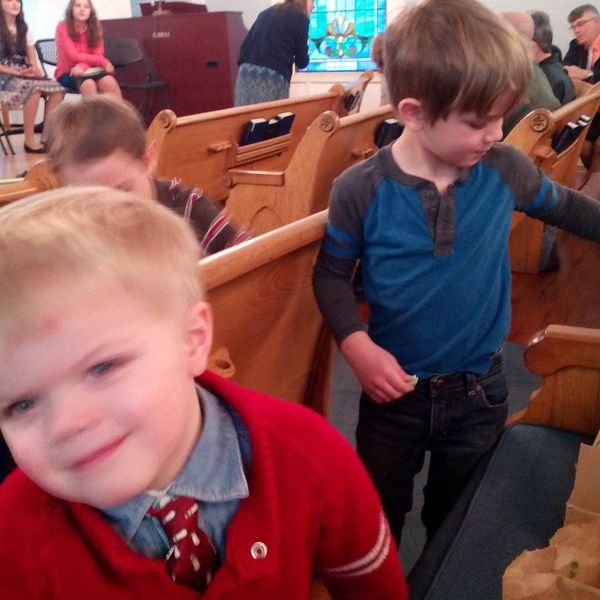
Dressed for church. Novelty quickly decreasing.
Great line from the visiting pastor this morning: "We are not saved by good works, we are saved for good works."