
Erstwhile Okie on St. Mark's Place. "That which hath been is now; and that which is to be hath already been; and God requireth that which is past."
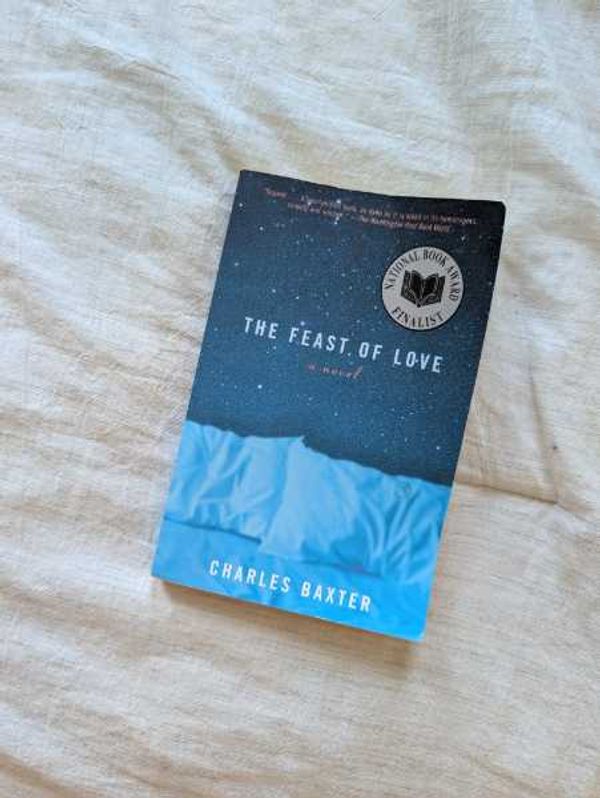
I picked up Charles Baxter's THE FEAST OF LOVE last August at a real low point because a stranger told me it was their favorite book. I always ask people their favorite movie or book and they typically say either that they have lots of favorites (wild how few people know the definition of the word favorite) or else they give some sort of mock-embarrassed shrug and name something popular and trite. But this person said THE FEAST OF LOVE so I bought it and have been reading it in drips and drabs for nearly a year.
It bounces between the perspectives of different ordinary people. It's lovely and moving but wasn't especially engaging. There's a woman who is sleeping with a married man and then starts dating someone else. She ends up marrying the latter but fails to fall out of love with the former so they divorce and she goes back to the married man. It made me irrationally angry, as every affair in a book or movie always does. Which made me wonder why I always relate to the cuckold rather than the lover.
Anyway, it was well done but I doubt I'll give it much thought.
· 1 min read
1 years ago
#BooksOf2025
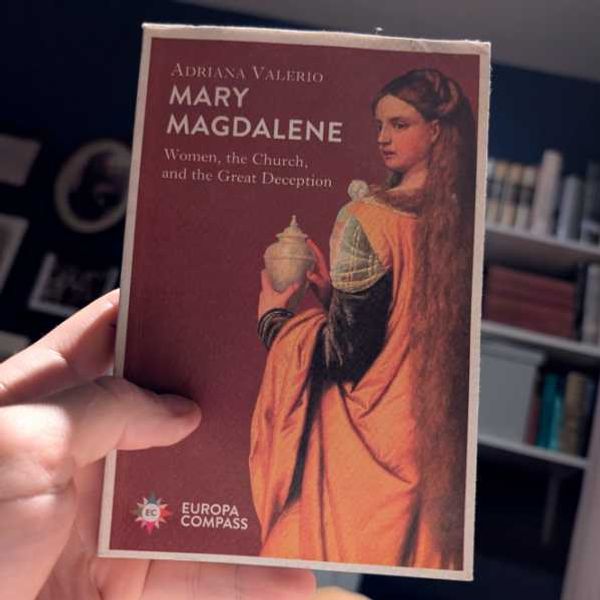
3. Mary Magdalene: Women, the Church, and the Great Deception
6/10
GOOD: Brief, accessible, and interesting points
BAD: Feels a bit cursory; an assemblage of proofs of a point that doesn't need much proof
Not thrilled to be sharing only my third book of the year well into March! In fact, February was dominated by The Thin Red Line, with which I was nearly finished when Lent arrived and I decided to only read explicitly Christian literature until Easter.
At any rate, this little volume had caught my eye in The Strand a while back, so I picked it up.
At its heart, the book critiques the denial of authority of women in the Church, pointing to Mary Magdalene as the first Apostle; having been the first to proclaim the news of Christ's resurrection. Interwoven is an examination of the conflation of unnamed women in the Gospel with her, making her, in church tradition, a prostitute though this is not a Biblical view.
That's really about it, but the point is illustrated by various gnostic texts and apocrypha (new to me was the x-rated Greater Questions of Mary.)
Quick and interesting read, but probably not especially memorable.
· 1 min read
1 years ago
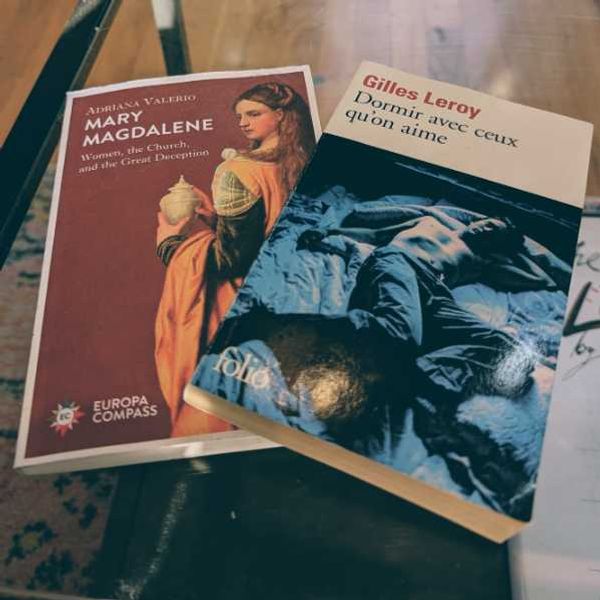
Rewarded myself after a long visit to the dentist yesterday with a trip to the Strand. Mostly to look for a copy of Strong's Concordance, which they didn't have, but in the section where it would have been, this little book on Mary Magdalene caught my eye (my interest kindled from the recent read of HOLY BLOOD HOLY GRAIL). Then I had the idea to buy a French novel to see if throwing myself into the deep end might bear any fruit. It's interesting to slowly crawl over a sentence as one might when one is four years old.
· 4 min read
1 years ago
#BooksOf2025
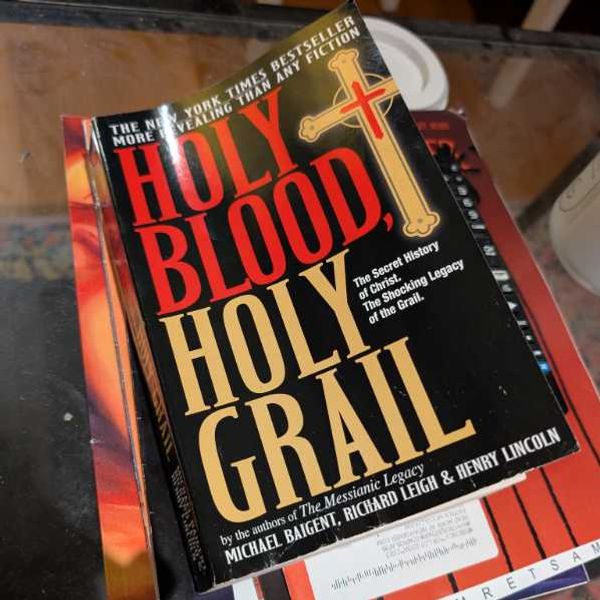
2. Holy Blood, Holy Grail by Michael Baigent, Richard Leigh, and Henry Lincoln
6/10
GOOD: Fascinating history from a number of discrete periods
BAD: Since debunked; Silly logical contortions to align with the desired conclusion
I'm going to be in Paris in May for meetings and wanted to take advantage of being on the continent by squeezing in some culture. Somehow I heard of a basilica in the South of France where Mary Magdalene's purported skull is displayed inside of a golden body. Evidently, there's a monastery with spartan accommodations to host pilgrims who then have to hike through the woods to access it. It seemed interesting, like something the characters in an Italian neorealist movie would do.
I mentioned it to a friend who referenced this book and some complex conspiracy about Mary Magdalene having been married to Christ and borne his children and carried the Holy bloodline to France. Popularly known more recently as the underlying conspiracy of The Da Vinci Code. So I bought the book and dove in.
It begins with the story of a priest in the late 1800s having been assigned to a tiny parish in the South of France. He eventually refuses the Church's order to be moved to another parish, seems to exhibit a sudden great wealth, behaves strangely, and finds hidden ancient parchments left by a Knight of the Crusades.
From there we try to establish that the famous Knights Templar were patronized by a secret society later connected to a particular Frankish royal family which lost power but seemed to have many prominent descendants in later centuries behind many major historical events.
SPOILER ALERT: This royal line was sired by Jesus, who was just a man, and if it is ever restored, it will unite Jews, Christians, and Muslims as the human view of Jesus is acceptable to all.
It's a pretty dense book, and they work through each step of this methodically. Much of their source material has, in the forty-plus years since publication, been debunked as fraudulent, but while they contort and connect and make spurious leaps, they do it all over a background of well-researched and interesting history. I learned a lot about the Knights Templar, and the Kingdom of Jerusalem, and the history of Franks and France and Visigoths. I also learned a lot about the Holy Grail (for instance that the word 'grail' has no other meaning than to refer to the Holy Grail...) and the literature around it.
But the part of it I enjoyed the most was the Biblical criticism. I consider myself a Christian Fundamentalist, and genuinely hold the admittedly absurd and indefensible view that the Bible is literally true and inerrant. But if you really believe in something you should be comfortable with it being assailed.
Reading about the Roman Emperor Diocletian's role in destroying much of the Christian Canon was fascinating, and I find arguments that the established Gospel was molded to be acceptable to Roman authorities compelling. There are also some compelling arguments that Jesus was not a humble carpenter but a well-to-do and well-connected member of an established Messianic line. Even relatively minor arguments that, for instance, the beloved disciple of the Gospel of John was not John, but Lazarus, were fascinating.
So on the whole, I don't ascribe a lot of value to the book, but it proved as fun a way as any to learn about topics I might not otherwise have been exposed to. And I admire a peripheral stated goal which is to united discrete scientific disciplines in the pursuit of truth. There's an aside about that I found thought-provoking:
"Why, then, had the fragments of the puzzle not hitherto been assembled into a coherent whole? [...] Since the so-called Enlightenment of the eighteenth century, the orientation of Western culture and consciousness has been toward analysis rather than synthesis. As a result our age is one of ever-increasing specialization... In consequence the diverse spheres covered by our inquiry have traditionally been segmented into quite separate compartments... [F]ew experts on the Grail romances have been historians... Similarly historians of the Templars and the Crusades have, like all historians, adhered closely to "factual" records and documents... To suggest to such a historian that the Grail romances might contain a kernel of historical truth would be tantamount to heresy, even though Schliemann, more than a century ago, discovered the site of Troy by dint of careful reading of Homer."
I love this as a defense of "fiction" as often being a greater aid of truth than "non-fiction" and as an exploration of what truth is generally.
· 1 min read
1 years ago
#BooksOf2025
1. Less by Andrew Sean Greer
5.5/10
GOOD: Funny, engaging, well-written
BAD: Blow-by-blow from a single perspective, self-indulgent
Finished my first novel of 2025 last night (though I read the majority of it in 2024). Less by Andrew Sean Greer. It was fine. Engaging and fun and a few very funny lines, eg:
His first response to Peter was to ask: "How did they even know I was gay?" He asked this from his front porch, wearing a kimono.
The fact that it's not dissimilar from stuff I've written and gotten nowhere with, and that it won the Pulitzer probably played no small part in engendering some bitterness... But it also does the thing that I used to love and can't stand anymore, which is to paint as realistic a world in which literary novelists have any sort of recognition or relevance.
The protagonist, Arthur Less, is an aging novelist, and a minor one by all accounts, who finds fans among the working class he encounters in different countries. It's writer porn. By writers and for writers.
There's also an under-developed thread that turns out, in the end, to be the big pay-off, which felt a bit pat and uninteresting.
I'm also a bit squeamish with male physical intimacy, and there's that throughout the book, though it's perfectly tasteful, but it probably didn't help its chances of winning me over.
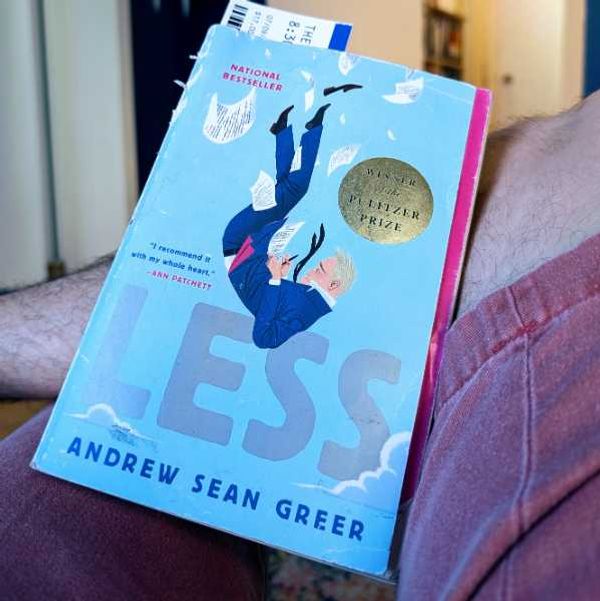
Currently reading.
· 1 min read
2 years ago
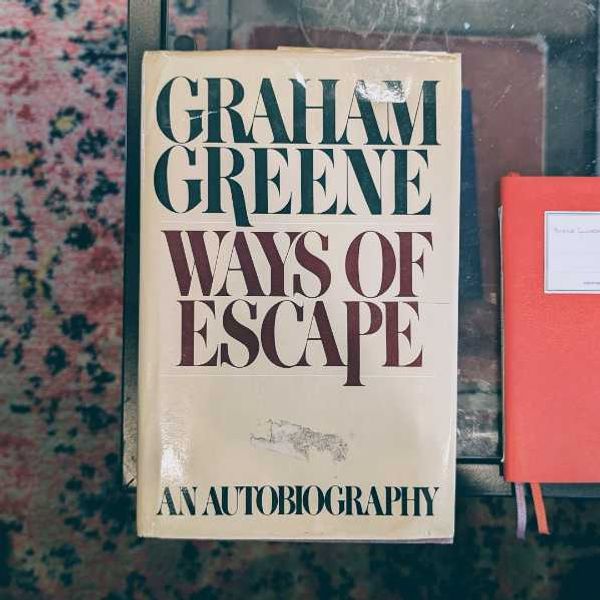
Just finished Graham Greene's Ways of Escape. My favorite author, along with Christopher Isherwood, I've since read all of his novels and have been reduced to his latter-day autobiographies. They sort of read like the fat cut off from the meat of his fiction. Nothing more than lovely travelogues, as from his account of Israel after the Seven Days War:
"Only an occasional group of Egyptian tanks retained a scorched, upright dignity and sometimes even faced in the direction of their enemy. Some trucks had started through a grove of date palms towards the blue still sea as though their drivers hoped to escape from war. The bouquets of dates hung overhead out of reach, brown, orange, yellow, scarlet: the trucks failed to reach the white beach before they were sent up in flames."

Follow-up to the enjoyable gothic-romance potboiler.
#toread

New train read for a rainy commute.

#trainlife. First time reading Camus. So far inclined to let it be the last. 🥱🤮
· 1 min read
4 years ago
Excited to learn that Tom Perrotta has put out a sequel to ELECTION via a review by Katy Waldman in the New Yorker. Loved this quote of hers: "Perrotta evokes, too, the contradictions of American ambition: how fundamentally our bootstrapping ideals conflict with our cult of destiny... it may turn out that scrambling for favor has, by dint of the effort itself, disqualified you."
· 1 min read
4 years ago
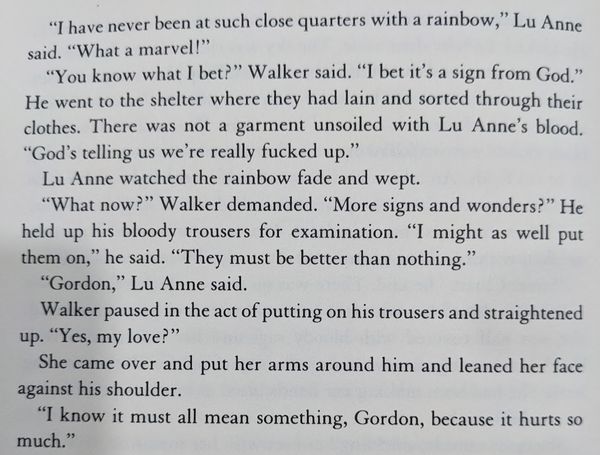
Been working on a writing project that involves movie-making so have been reading all the novels that center on that I can find. Seems like I inevitably like them. Already had Fitzgerald's Last Tycoon and Isherwood's Prater Violet on my list of favorites, but added Day of the Locust and now Children of Light by Robert Stone.
It started off as a sort of tamer Hunter S. Thompson hedonist travelogue--light, fun reading--but wound its way to an exploration of love and mental illness with a surprisingly devastating ending. Sort of book that makes you want to know the author.
It started off as a sort of tamer Hunter S. Thompson hedonist travelogue--light, fun reading--but wound its way to an exploration of love and mental illness with a surprisingly devastating ending. Sort of book that makes you want to know the author.
Just started reading THE MOVIEGOER last night. Great so far--baffled that I'd never heard of it before last week.
Just finished RIPLEY UNDER WATER, and have nothing left to read in the "Ripliad". Au revoir, Tom. I will miss your casual gardening, the purposeful order of your life of leisure, and your afternoon Calvados and Gitanes.
Reading BRIDGE OF SIGHS--don't understand how it is that Richard Russo can be so great without being very good.