
Erstwhile Okie on St. Mark's Place. "That which hath been is now; and that which is to be hath already been; and God requireth that which is past."
· 3 min read
1 years ago
Have had a miserable couple weeks; all of it (as always) first-world problems that gnaw at me until I manufacture genuine crises. Then, having it out of my system, I crawl gradually back into the quiet life of dull daily habits which I remind myself is a life 99% of the world would swap for.
In the midst of the crawl-back, I reluctantly return to a daily Bible reading. Of course I know it's critical. Of course I know it's the answer. But I never think I'll get anything from it, especially since my current reading plan is a survey of minor prophets.
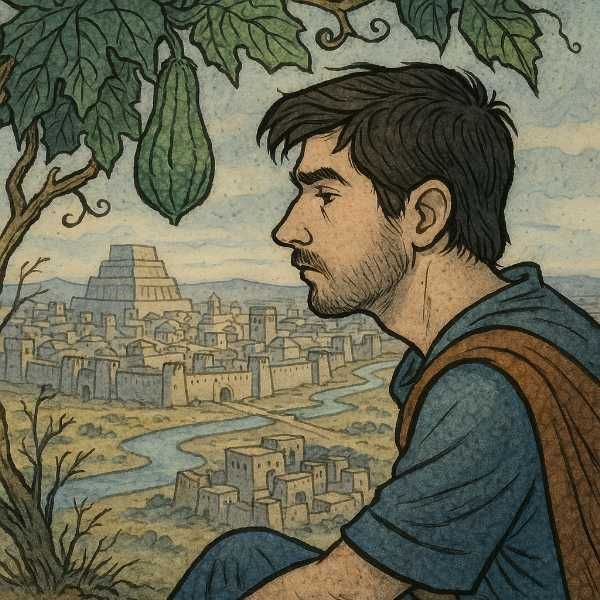
Just the same, I picked back up today and it was the Book of Jonah, which every kid who ever spent a day in Sunday School knows since he got eaten by a fish or a whale or something. But that's really a pretty minor detail.
The real story is that God tells him to go save a group of people he hates and he tries his best not to. When left with no choice, he (sort of) does what God tells him to do, it works, and Jonah is incensed because he does not want them to be forgiven; they don't deserve it.
Ultimately God tries to give Jonah an illustration by providing him shade from the sun then killing the thing that provides the shade. Jonah is upset and God asks essentially whether he should care about the loss of the thing shading him more than a group of people who did not know any better than to be the sort of people Jonah hated.
It's a nice lesson about having compassion for enemies, but I've never really struggled with that. I forgive everyone everything because:
1) I tend to avoid situations where anyone could wrong me, and
2) I don't think I have sufficient value that it would be anything other than absurdly self-important to hold a grudge.
But this morning, I saw the story through the prism of when the enemy is yourself.
I could go on, and I usually do, but I'd just encourage you to read it (the Book of Jonah has only four, very short, books--maybe a ten minute read).
I'll only say that God does not need our guilt or our judgment, He needs our obedience. And even that, He can wait on. Nearly every action of Jonah's is disobedient in this book. And in a sense he recognizes it, and believes that God's just response should be to kill him. He has himself thrown into the sea, and eventually commands God to just kill him outright.
But his justice is not God's. And ultimately, he is left with a much greater challenge: to accept God's compassion.
For me at least, that feels easy to do unto others, but when I see myself as the wicked people undeserving, and also myself as the person demanding divine punishment, I find the real challenge.
The thing that comforted me most is in the last verse when God asks why he should not spare a city full of people who "cannot discern between their right hand and their left hand".
When I hate myself, I think I ascribe a certain importance. It reminds me of crying once when I was very little when my dad opened a present that had been labelled as coming from me, when in fact I hadn't done anything to help getting it. I didn't even know what it was. As a father now, I know that sort of response from my child would make me sad.
Today too, though I consider myself a wise, mature person much more culpable in his sins, I believe that I am still, in God's eyes, a child who "cannot discern between their right hand and their left hand".
· 1 min read
1 years ago

I've been getting a kick out of these wizard memes on Instagram, but found this one quite touching.
It reminded me of the verse "It is of the Lord's mercies that we are not consumed, because his compassions fail not. They are new every morning: great is thy faithfulness."
And arguably not really related but a line from The English Patient that often pops into my head: "Every night I cut out my heart. But in the morning it was full again."
· 1 min read
1 years ago

Lent has been wild and wonderful and unexpected with no shortage of opportunities to be (like C.S. Lewis) Surprised by Joy. In the midst of all that's gone on and all that remains in the final days of Holy Week, it's amazing to finish Nicky Gumbel's one-year devotional read-through of the Bible (which I think I've been working on through fits and spells for 2.5-3 years... 😳). This is the third read-through I've done and it's always a strange feeling to come to the end.
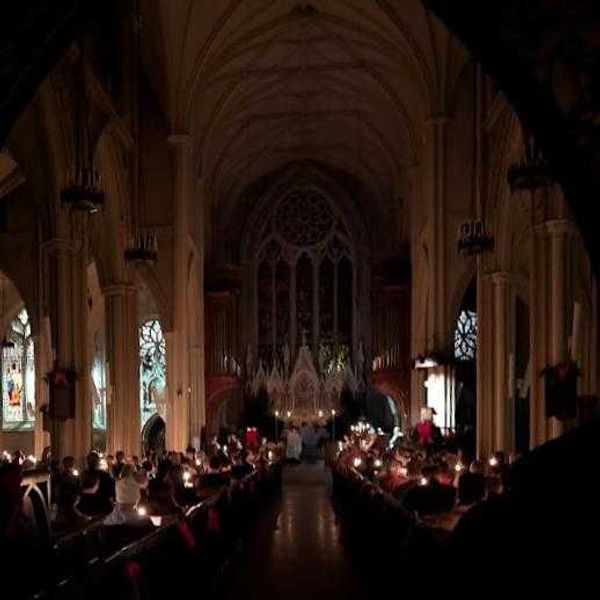
It's been a mad rush since Christmas Eve, so this is quite belated, and many clever-er men than me have made the observation better than I can, but it really struck me at the candlelight service, in this grand ornate sanctuary on Broadway, wealthy and homeless alike singing praises to a savior born two millennia ago to peasants.
· 3 min read
2 years ago
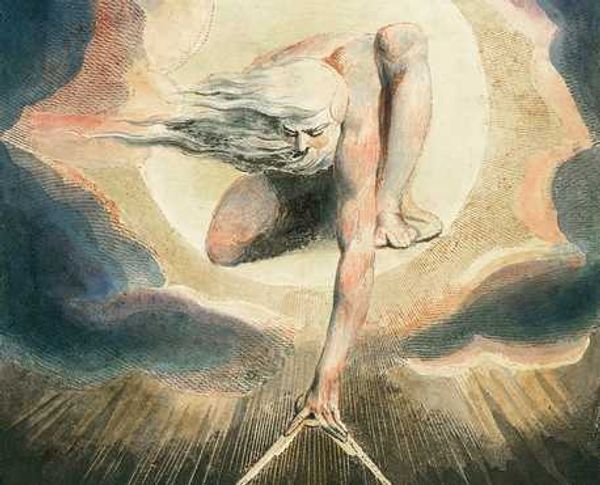
In church this past Sunday, the Psalm reading came from Psalm 90. One line of it struck me: Make us glad according to the days wherein thou hast afflicted us. The bit that struck me was in the idea that God afflicts us.
I read and enjoyed a book recently, recommended to me by my church rector: The Will of God by Leslie D. Weatherhead. The basis of it is to critique those that might, in the midst of suffering, say that it is God's will; that it is never God's will for us to suffer, but that in our liberty, we are not restrained from acts of which the natural consequence is suffering.
While I think this view has a lot to commend itself and affords us a concept of a loving God better aligned with our earthly definition of love, it replaces a God who would intentionally injure us with One who merely lets us be injured. I think both have downsides.
Either way, the verse in question leaves no doubt in a straightforward reading that God does not just let us be afflicted, He afflicts us.
It might be splitting hairs, but I personally favor a God who, seeing me running into traffic would snatch and beat me rather than watch on, determined to let me learn my lesson naturally, even if the injuries were equal in either scenario.
I don't know why I felt compelled to write about this, but I did, and in doing, went to review the Psalm in full and was struck further by how the line that had first caught my attention actually ranks pretty low in the litany of active cruelties described.
Thou turnest man to destruction; and sayest, Return, ye children of men... (read: An older sibling: "stop hitting yourself!")
I was struck too by Before the mountains were brought forth, or ever thou hadst formed the earth and the world, even from everlasting to everlasting, thou art God. but for no reason other than that it brough to mind Job; God demanding of him Where wast thou when I laid the foundations of the earth?
So it seemed especially interesting that Psalm 90 is, by tradition, the only Psalm attributed to Moses, making it the earliest, which again parallels Job, as that book is similarly cited as being the earliest written book of scripture.
What does it mean that the earliest question posed by man was why we suffer? And what does it mean that both Job and Moses, who had direct interactions with the Almighty, understood the answer to be that He willed it so?
Beats me.
But it has gotten me thinking about how dismissively I approach the Psalms, which I don't think is unusual among thoughtful Christians. They plead for God to torture enemies, they lament our unjust sufferings; all of which seems wrong through the prism of Christ's teaching. But I think it suggests that I ought to find a way to adjust my thinking rather than to somehow find clever contextualizations that bring it into alignment with how I think it ought to be.
I'm planning on trying to actively read through them with a mind for how I can genuinely pray them. I have a copy of C.S. Lewis' Reflections on the Psalms which I've never read past the introduction, but which might be a useful guide.
· 1 min read
2 years ago

[Pictured: Me at a low-point in 2020.]
Anyone who would cite Job or try to compare themselves would be deserving of the ensuing eye rolls, but throughout the last week I've kept thinking of the line "the Lord blessed the latter end of Job more than his beginning". I kept waking up overwhelmed with gratitude and just praying a silent, repeated thank you. It was a quiet week, but I think it was the best of my life.
In the early months of the pandemic, I deleted my social media because I didn't have anything left to share. My seventeen-year marriage had met its catastrophic end; I'd left the charming little country house I'd called home for a decade in favor of a run-down apartment in the shadow of a feed mill; my job had joined a few others on the chopping block as COVID wrecked the college's budget.
And now here I found myself, waking in an apartment overlooking one of my favorite blocks in Manhattan, its bedrooms occupied by a pair of sons that think I hang the moon. I made decisions, good and bad and most all of them reckless, that contributed to this, and plenty that should have precluded it. But somehow, in tabulating the ledger, Providence credited more than it debited and I find myself occupying a life vastly fuller than the sum of my efforts.
I recently read a book my church's rector had recommended to me: The Will of God by Leslie D. Weatherhead. A line that stuck out to me reflected on loss and hopelessness, and compared it to what the Apostles must have suffered upon the death of Christ: "But they were wrong, weren't they? [...O]ne day, like them, you'll find out how wrong you are and be sadder at your despair than at your loss."
· 1 min read
2 years ago
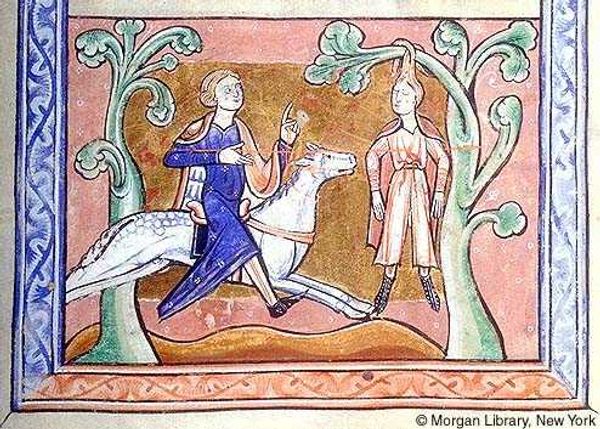
Reading through 2 Samuel I'm struck by the similarity between David's feelings for Absalom and God's for His people.
[33] And the king was much moved, and went up to the chamber over the gate, and wept: and as he went, thus he said, O my son Absalom, my son, my son Absalom! would God I had died for thee, O Absalom, my son, my son!
Absalom had no redeeming qualities, and died justly (hanged and pierced Christlike from a tree no less) in the midst of rebellion against his good and loving king and father. Yet in spite of it, David wished he could have died in his place.
"Soon afterwards he appeared to lose hope of future worldly fame, and he too was converted to the monastic life."
· 2 min read
3 years ago
I've undertaken reading through the Bible in its entirety, which I haven't done in a few years. It's inevitably a faith-challenging experience because--to really distill it:
1. I have long since committed to fundamentalism and the view that the Bible is literal and inerrant.
2. The Old Testament is ridiculous.
So doing this kind of study, as opposed to just reading the more sort of guiding, nourishing stuff of the New Testament can get me into a mode of my religious life being more intellectual than spiritual. It led me, this morning, as I was praying before doing a reading, to ask God why He prizes faith so much. Why would He rebuke the disciple who wanted to see His wounds before believing He was truly resurrected?
Outside of one's own religion, I don't think anyone ever sees blind unquestioning faith as a virtue. And God encourages reason, calling us to "be ready always to give an answer to every man that asketh you a reason of the hope that is in you."
One of the things that past readings through the Old Testament did give me though, was astonishment at how little miracles can move people. The very people that saw the Red Sea parted and walked through it with Moses in very short order questioned the very existence of God. And is that really any different from me coming into consciousness every morning, drawing breath that puts some parts of the ether into my blood and lends me the ability to see, speak, move?
But still, I tried to go beyond my own mental justifications and asked God to give me something in my reading as an answer. Knowing that my reading was something He smiled on, serving as a knock on the door that He promises to answer.
And surely enough, I was satisfied with the New Testament chapter I was given, in which the disciples--not one, but all of them, apparently--ask Jesus a question that I think was very similar, in a sense, to the one I was asking: Why speakest thou unto them in parables?
His answer, from Matthew 13:11 - 17 is worth reading (Since, you know, they're the words of Christ), but in particular I appreciated:
By hearing ye shall hear, and shall not understand; and seeing ye shall see, and shall not perceive: [...] But blessed are your eyes, for they see: and your ears, for they hear.
[...]
many prophets and righteous men have desired to see those things which ye see, and have not seen them; and to hear those things which ye hear, and have not heard them.
Sammy's bedtime prayer: "I'm sad you died on the cross, sometimes sad things happen."
Sammy's bedtime prayer tonight: "Dear God, I wish I wouldn't die. Amen." :|

Just happened upon Dad's bible and noticed verses on the flyleaf. I can't help but be grateful for the countless lessons he left me, even 20 years on. Our father's voice is never any more distant than we want it to be.
If God had a refrigerator your picture would be on it.
#Proverbs29 #Proverbs29:13

Tyler Hill Resurrection Sunday
Great line from the visiting pastor this morning: "We are not saved by good works, we are saved for good works."
Gotta' turn up the upload quality on this app...